Thermador Oven Not Heating? What to Check
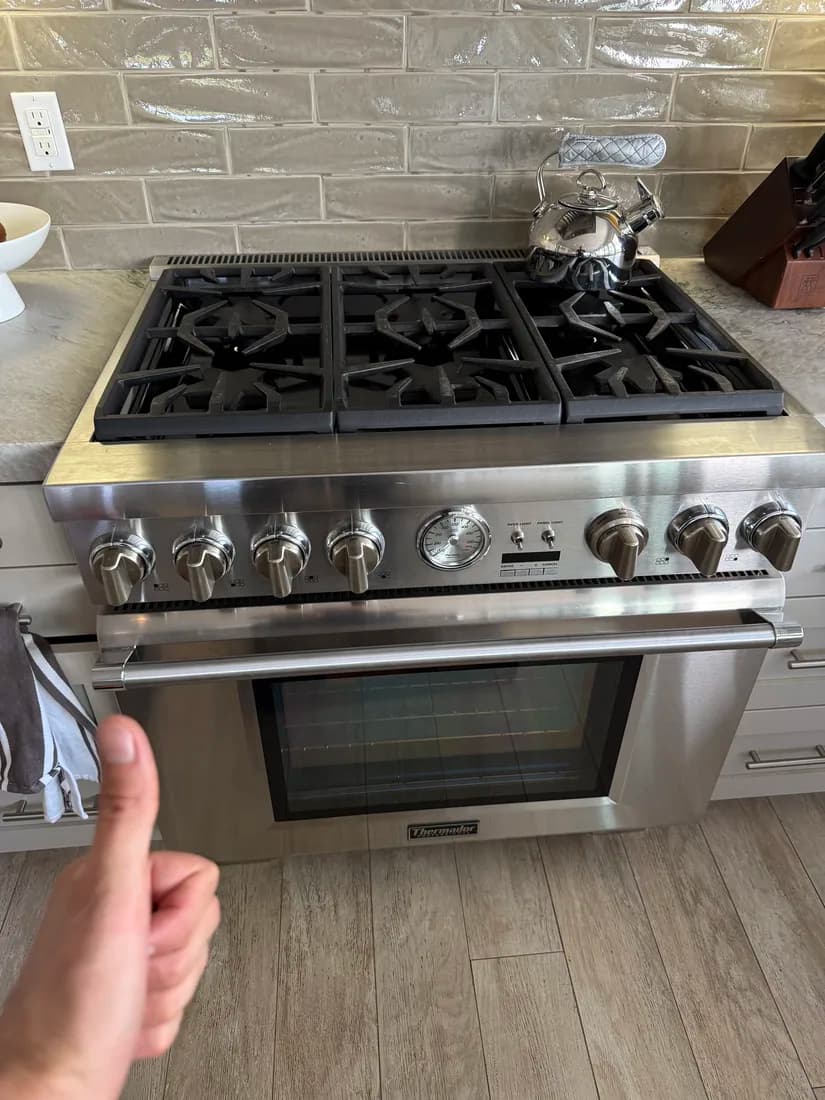
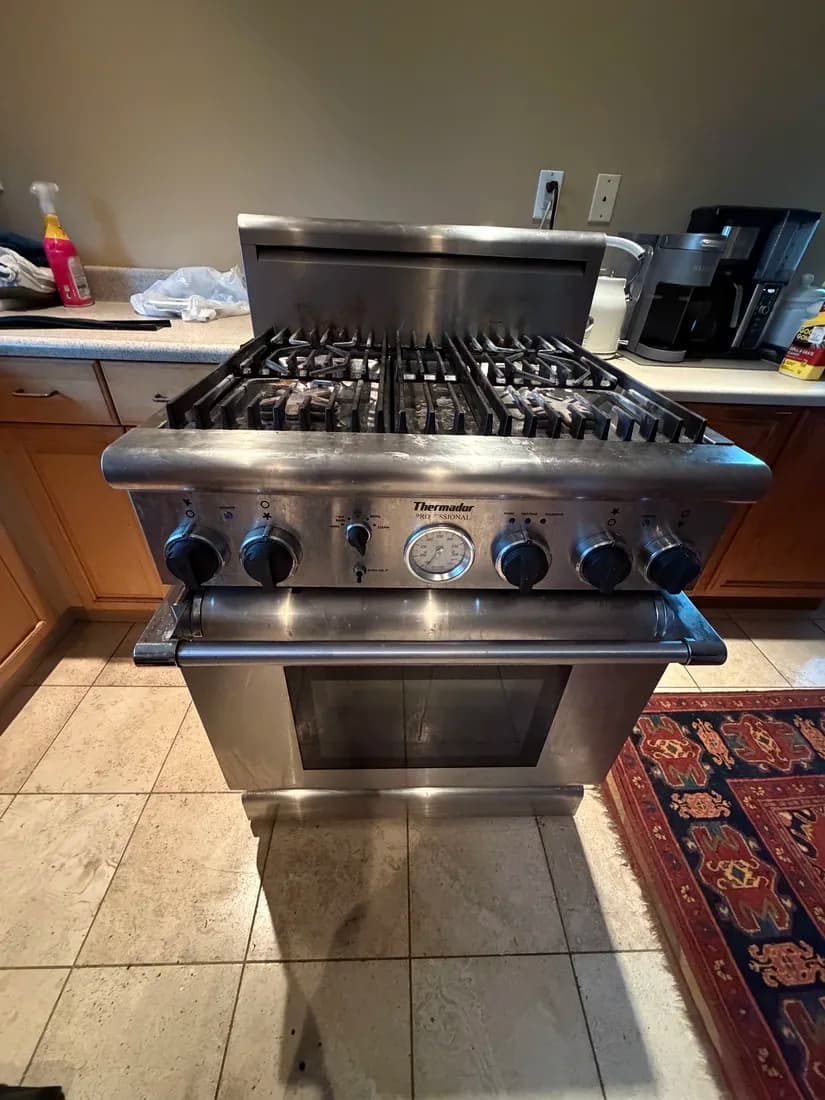
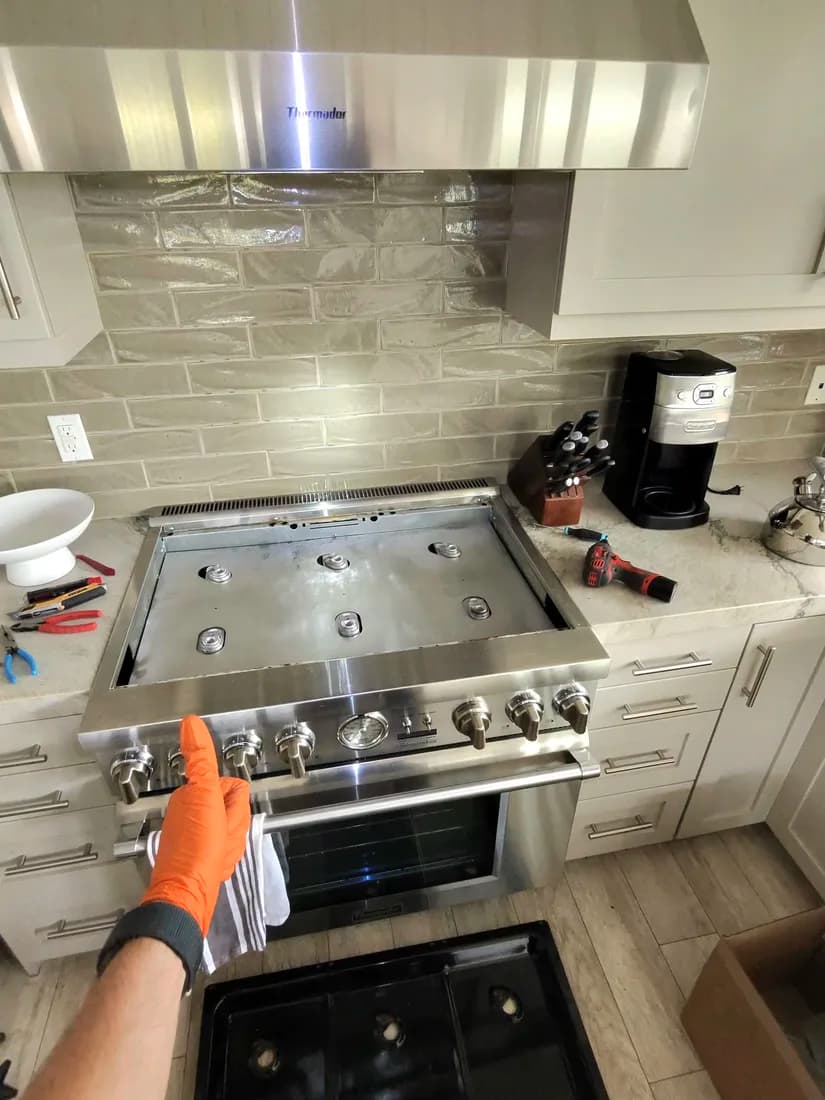
Inside a no-heat service call: cavity inspection, glow-bar and element checks, and probe readings taken with a meter.
Thermador Oven Won't Heat? Start Here
It's 5:30, the casserole is on the rack, and the oven is still stone cold — or it beeps like everything is normal while dinner refuses to cook. When a Thermador gas or electric oven stops heating, the fault almost always traces back to one of five parts, and you can rule out the free explanations from your kitchen floor before anyone charges you a dime.
The complaint takes a few shapes. One oven crawls to 200°F and parks there — the preheat chime never comes. Another flashes a fault code halfway through a batch of cookies and goes dark. The sneakiest version keeps a perfectly normal display — 375°F, says the panel — while the chicken inside is still pink an hour later, because the temperature probe is feeding the electronics bad numbers. Different behaviors implicate different parts, so notice which one you're seeing: it's the first thing a technician will ask about.
Below: the five failures behind most cold Thermador ovens in our San Diego service logs, the checks any homeowner can run with nothing but a flashlight, and how the service visit itself plays out — including what appliance repair typically costs in San Diego, so there are no surprises on the invoice.
Five Reasons a Thermador Oven Stops Heating
1. Worn Glow-Bar Igniter (Gas Ovens)
Gas Thermador ovens don't run a standing pilot light. A glow bar heats up first; once it draws a specific amount of current, a safety valve lets gas flow and the burner lights off the hot bar. The design is deliberate — no glow, no gas, no chance of filling the cavity with unburned fuel.
Age is the enemy here. Years of heat cycles raise the bar's electrical resistance until it still lights up orange yet never pulls the current that the valve is waiting for. Because the part still glows, homeowners assume it's healthy — it isn't, and this exact scenario tops our gas no-heat calls.
What to listen and look for: a relay clicks, an orange glow appears low in the cavity, and then... nothing. No soft roar of flame, no warmth. Glow without ignition is the classic signature of a bar due for replacement — a quick, contained fix once it's confirmed.
2. Burned-Out Bake or Broil Element (Electric Ovens)
An electric Thermador heats from a lower bake element and an upper broil element. Lose one, and that mode simply stops producing heat — baking dies while broiling still works, or the reverse.
There's no repairing a failed element; the part gets swapped for a new one. It's routine work, and it's the leading reason an electric oven bakes cold or wildly unevenly.
Grab a flashlight and inspect the coil while the oven is off and cool. Healthy: an even, dull-grey loop. Failed: a split, a blister, or a shiny burn mark somewhere along the run. Partial failures show up during preheat as a coil that lights strongly in one section and stays dark in another — it might make some heat today, but it's finished.
3. Drifting Temperature Sensor
A thin metal probe in the corner of the cavity — the RTD sensor, in service manuals — reports the temperature to the control electronics. When its readings drift, the oven acts on bad data: it stops heating too soon, overshoots, or never decides the target was reached.
Drifted probes usually report hot, so the board cuts the heat before the cavity actually gets there. Confirming it takes a resistance measurement — around 1,080 ohms at room temperature, climbing smoothly as the oven warms — which is exactly the test we run on every no-heat visit.
The giveaway is a "working" oven that ruins food. The display says one number, a cheap standalone oven thermometer says another, and baking results go sideways. If those two readings disagree by 25 degrees or more — and a new element didn't change anything — suspect the probe.
4. Control Board or Relay Trouble
Everything routes through the electronic control: it decides when the igniter energizes and when an element powers up. A shorted relay or a failing board interrupts that chain, and the usual evidence is a fault code, random shut-downs, or buttons behaving strangely.
From the outside, board-level faults mimic probe and element failures, so this diagnosis takes meter work rather than symptom-guessing.
Cycling the breaker may clear the code for a day, but a genuinely failing board brings it right back — and a relay stuck closed can keep an element live when the oven believes it's off. Treat a repeating code as a service item, not a quirk to live with.
5. No Gas Reaching the Oven (Gas Models)
Before blaming a component, rule out the supply itself: a shut-off valve turned partway, a pinched connector line behind the range, or weak pressure at the house.
Think back — did the heat quit right after countertop work, a deep clean, or the range being pulled out from the wall? Valves get nudged shut all the time without anyone noticing. Quick test: light one of the cooktop burners. If the cooktop flames up normally while the oven below stays cold, the supply is fine and the problem is internal — very often that glow bar again.
What Our San Diego Techs Actually Find
Our service logs are remarkably consistent. Gas ranges: the glow-bar igniter accounts for the clear majority of no-heat verdicts — faint glow, not enough current draw, valve never opens. Electric and dual-fuel units: a dead bake element leads, with a drifted temperature probe in second place, quietly shutting the heat off early on ovens that look fine.
The visit that surprises homeowners most is the oven that seems to work: the panel reads correctly, the element lights, and dinner still comes out raw. Nine times out of ten the probe is misreporting to the board — which is why we put a meter on the probe and the element instead of trusting the display. A tidy readout proves nothing; resistance numbers tell the real story.
What You Can Safely Check Before Calling
A handful of checks are safe for any homeowner, cost nothing, and occasionally save the service call entirely. Everything beyond them involves 240-volt circuits or gas plumbing and belongs with a technician.
Run down this list first:
Leave alone: igniter current testing, element removal, board connectors, and anything on the gas side. None of it is homeowner territory, and a slip there costs far more than the visit you were trying to avoid.
- The wall shut-off valve behind the range is fully open
- The oven's breaker in the panel hasn't tripped — including a half-trip that still looks "on"
- No self-clean cycle has left the door lock engaged (a locked oven won't heat)
- No delayed-start or timed-bake program is quietly holding the oven off
What Happens During the Repair Visit
Booking with us gets you a technician with a meter, not a parts-guesser. The on-site routine:
The visit starts at a flat $90, credited to the job if you approve the quote — and the finished repair carries a 90-day parts-and-labor warranty.
- Meter first: resistance and continuity readings on the igniter, elements, and probe identify the failed part by the numbers
- Gas verification: on gas ovens, we confirm healthy flow and pressure to the burner
- Solid parts: replacements chosen to hold calibration, not just to get the oven warm this week
- Proof at the end: the repaired oven gets verified against a reference thermometer before we pack up
The Short Version
- Gas ovens: a worn glow-bar igniter is the usual verdict
- Electric ovens: a failed bake element leads the list
- Homeowner checks: supply valve, breaker, door lock, delay settings
- Technician work: igniter, element, probe, and board replacement
- On-site time: figure one to two hours, diagnosis included
- Coverage: 90 days on parts and labor — San Diego-wide since 2019
Know Your Model: Thermador Lines Compared
Failure patterns track the product line, so knowing which one sits in your kitchen shortens the hunt.
- Pro Grand (PRD, PRG): the 48- and 60-inch twin-cavity ranges. Their heavy-duty igniters tend to quit abruptly instead of fading, and probe trouble outnumbers board trouble.
- Pro Harmony (PRL, PRD-P): the 30- and 36-inch ranges. The compact cavity preheats fast, but the igniter fires more cycles per year — frequent bakers see glow-bar wear arrive earlier.
- Masterpiece (ME, MED): built-in electric wall ovens. Element burnout is the front-runner, convection-fan complaints follow, and the touch membrane can act up as the unit ages.
- Pre-2015 wall ovens (POD, POM): plenty are still cooking in San Diego. Factory parts occasionally need a few extra business days when the piece isn't stocked on the truck.
- Dual-fuel ranges: the electric oven can die while the gas cooktop soldiers on. That's an electric-oven diagnosis on its own — the range as a whole is fine.
The One-Minute Checklist Before You Book
A noticeable slice of "broken oven" calls end with no repair at all — one of these settings or switches was the whole story:
Nothing on the list matches? Book the diagnostic. It's $90 flat, it includes the meter workup and a written quote, and the fee folds into the repair price if you move forward.
- Door lock stuck after self-clean. An interrupted cleaning cycle leaves the latch closed. Once everything cools, press and hold cancel for about five seconds.
- Delayed start armed. Everything looks normal; the program is simply waiting for its start time. Look for a delay icon on the panel.
- One leg of the breaker down. The clock and lights run on 120V while the elements want 240V — so the display works and the heat doesn't. Cycle the breaker hard off, then on.
- Gas valve turned partway. Enough flow for a small cooktop flame, not enough for the big oven burner below.
- Sabbath or holiday mode. The panel responds but ignores temperature commands until the mode is switched off.
Habits That Keep the Heat Coming
None of this takes real effort, and together it heads off most of the failures above:
- Book an inspection every couple of years so igniter wear and probe drift get caught before the oven quits mid-holiday
- Keep the rear vent clear — no foil liners, no cookie sheets leaned against the back wall; the cavity needs to breathe
- On convection models, keep the fan grille clean so heated air actually circulates
- Once a year, park an inexpensive standalone thermometer inside and compare readings; a growing gap means it's time for recalibration
Cold Oven? Get a Straight Answer Today
Guessed part swaps are how oven repairs get expensive. We've handled oven work for San Diego households since 2019, and every diagnosis starts with meter readings, not hunches — then the fix, then a 90-day guarantee standing behind it.
If there's a gas odor, a burning smell, or a code that keeps returning, stop using the oven and pick up the phone. Most Thermador heat repairs in our coastal and central San Diego service area finish the same day.
Refrigerator and Appliance Repair — (858) 788-1552. A flat $90 covers the diagnosis, gets credited toward the repair, and the whole job is covered for 90 days.
Serving everyday kitchens from Mira Mesa and Clairemont to La Jolla, Del Mar, Carmel Valley, and Poway.
The Same Logic Works on Any Oven
The diagnostic ladder in this guide — supply first, then igniter or element, then probe, then board — isn't Thermador-specific. Electric ovens of every brand live or die on element continuity and probe accuracy; gas ovens on igniter current and valve behavior. Swap the badge on the door and only the part numbers change.
Whether the complaint is no heat, half heat, or a code you can't clear, our oven repair service handles Thermador alongside every major brand across La Jolla, Del Mar, Carmel Valley, Rancho Santa Fe, and greater San Diego.
Cold Thermador Oven — Cheat Sheet
- Gas oven, glow but no flame: Worn igniter until proven otherwise — the meter test settles it
- Electric, little or no heat: A burned-out bake or broil element
- Wrong temperature: Drifting cavity probe feeding the board bad numbers
- Codes / random shut-offs: Board or relay — technician-level work
- Safe DIY: Valve, breaker, door lock, delay settings — nothing beyond that
- Red flag: Gas smell or a repeating code: stop using the oven and call
Related Reading
Fixing one appliance has a way of raising questions about the next — these guides pick up where this one leaves off.
Basic checks done and the oven is still cold — or you smell gas, smell burning, or see a code that won't stay cleared? Make the call. Most Thermador oven repairs wrap up the same day: $90 diagnostic that rolls into the repair, 90 days on parts and labor.
(858) 788-1552